
Tax stamps ensure that governments receive their tax revenues. They are applied to consumer goods to confirm that the relevant authority has received the tax payment from the manufacturer. However, tax stamps have many other functions: they protect consumers from counterfeit products and help manufacturers to build and maintain a good reputation in the market. Pantec’s flatbed technology offers a highly efficient way of applying such tax stamps.

Recently, a RHINO® customer from North Africa contacted us to find out whether it would be possible to apply holographic foils with flatbed technology running in web direction. We took this enquiry as an opportunity to look into the production of tax stamps in detail. During this process, we found opportunities to optimise some process-related aspects. We developed a process to apply holographic stripes along and across the substrate with a web speed of up to 150 m/min with the RHINO®.
Our customer in North Africa has in the meantime switched to the RHINO® flatbed technology for all its tax stamp jobs.
Traditionally, tax stamps have been applied using rotary machines because flatbed technology is very challenging to use. There are essentially two issues that need to be addressed:
No wrinkles in holographic foil
The holographic foil must be applied precisely without any wrinkles on the substrate surface.
Zero waste between stripes
No holographic foil should be wasted — individually applied stripes must overlap precisely to form a continuous pattern.
Once these challenges are overcome, flatbed technology offers great advantages over conventional rotary stamping. One of them is the high speed of up to 150 m/min and a foil utilisation of over 95%. Flatbed technology achieves excellent results on all substrates, coated and non-coated. Furthermore, the tooling costs are only one fifth of those for rotary technology.
The setup of flatbed machines is also much easier compared to rotary machines. With rotary machines, several foil rolls are clamped, whereas only one foil roll is required with the flatbed machine.
.avif)
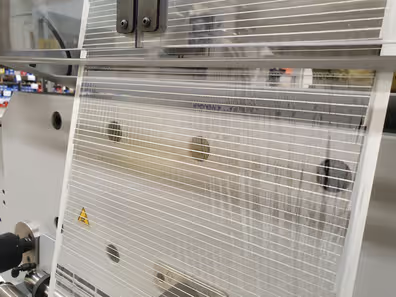
Pantec RHINO® — foil utilisation up to 95%.
In certain cases, it is required to apply the foil across the substrate. This can easily be done with the RHINO® by rotating the foil head 90°.
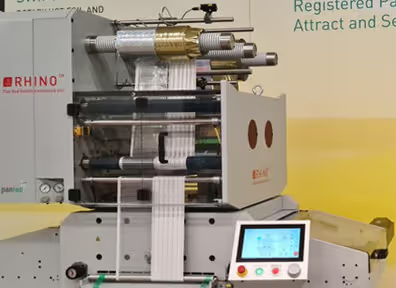

Foil head across the web
Foil head along the web

“Flatbed technology enables higher productivity in the application of holographic foil on tax stamps, allows stamping on open and closed substrates and impresses with the application of additional security features such as nano-embossing.”
Philipp Fatzer
Head of Production and Service, Pantec Schweiz AG
The flatbed technology offers not only the most efficient process to apply tax stamps, the RHINO® can also add additional security features such as nano- and micro-embossing, even in combination with a standard hot stamping and/or holographic foil. The so-called ‘Multi-Stroke Function’ of the RHINO® gives you the possibility to produce these different security features in one pass — increasing your efficiency even more.

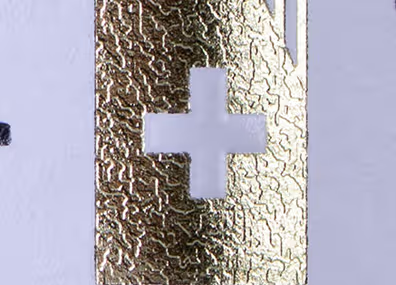
Security patch with foil micro-embossing, based on a holo lens, with gold and transparent foil, applied in flatbed
Micro-embossing — distortion of the metallised surface of the substrate during the stamping process creating impressive, optical reflection effects.
Based on the acquired know-how in the field of tax stamps, we have implemented the possibilities of flatbed stamping in two further projects.
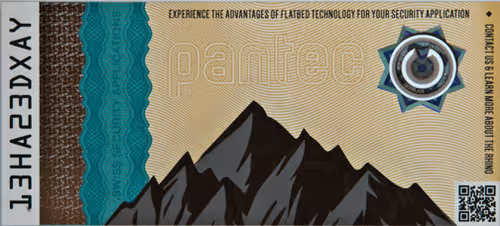
We created our own “Pantec Tax Stamp” to be shown at the Tax Stamp & Traceability Forum in Malta. We designed the label with the idea to be able to print it as a basic version with holographic foil only or to add a nano-structure as additional security features.


Basic version with holographic foil only
Basic version plus nano-embossing — 2-stroke Design
Nano-embossing is the deformation of the substrate surface during the embossing process, resulting in special optical effects. This creates an additional security feature that makes it much more difficult to copy the tax stamps. The application of holographic foil and nano-embossing takes place in two steps, but in one machine pass.
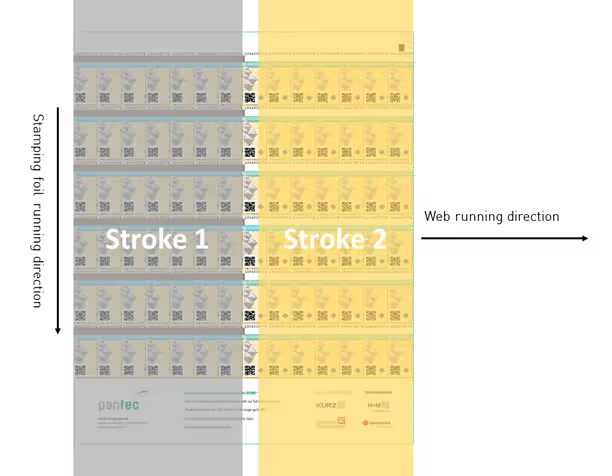
Pantec Tax Stamp — Multi-Stroke
Stroke 1: Application of holographic foil
Stroke 2: Foil & nano-embossing
With the first stroke, the holographic foil is applied. With the second stroke, the crosses are enhanced with a gold-coloured hot stamping foil and at the same time, a nano-structure is embossed into the hot foil to add a further security feature. Function meets design: tax stamp with holographic foil, gold embossing and complementary nanostructure.

Function meets design: tax stamp with holographic foil, gold embossing and complementary nanostructure.
Based on the experience of the first security samples for the Tax Stamp & Traceability Event in Malta, we developed another sample sheet focussing on “security features”. The enhancements selected for this are easy to implement and generate unique effects.
The samples presented each consist of a pre-print and inline applied embellishment / security features.
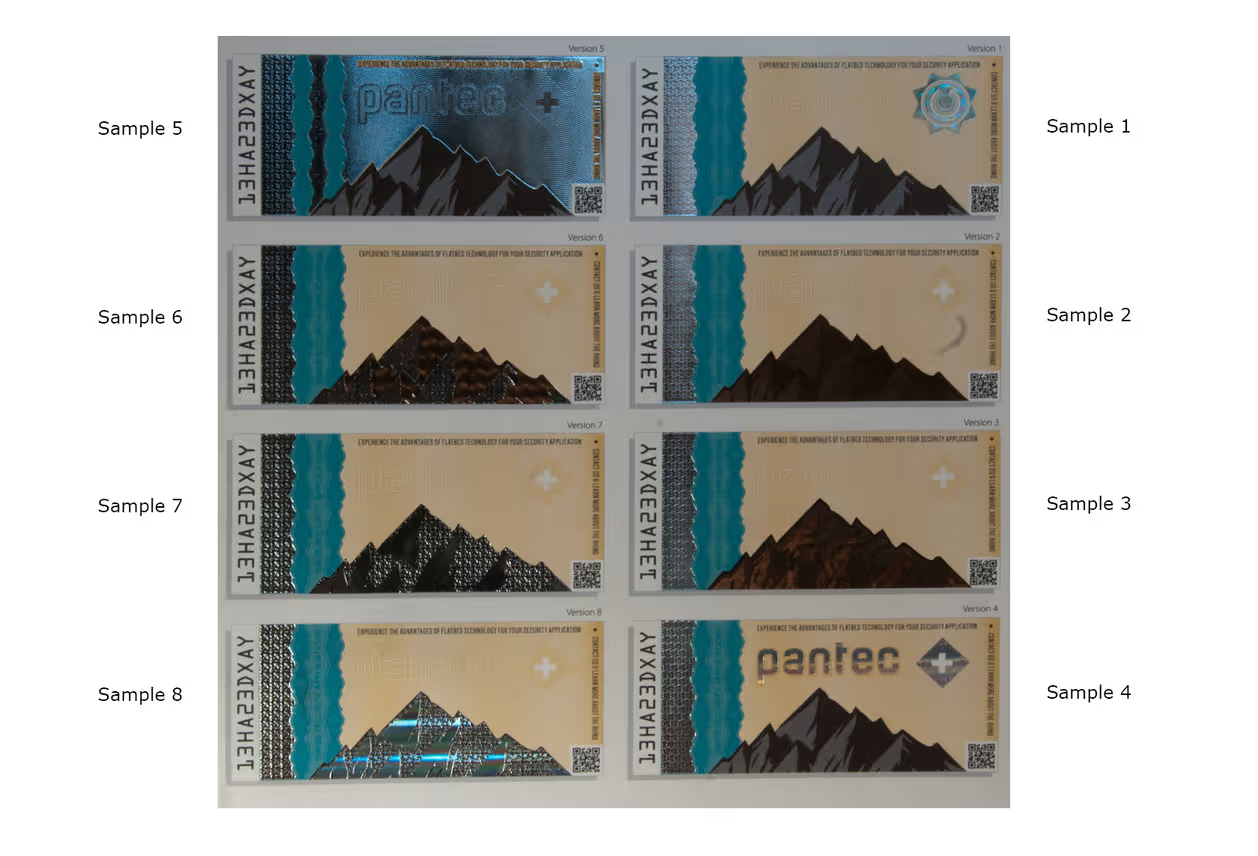
The eight examples at a glance
The classic single-image hot stamping foil can be provided with your logo or your recognisable symbol. The single-image hot stamping foil is applied in register.
The lenticular effect describes an optical effect that utilises the refraction of light to achieve extraordinary effects. In addition to the safety aspect, this effect creates enthusiasm among consumers.
With nano structures, very fine patterns are worked into the embossing tool. This distorts the metallised surface of the substrate during the stamping process and creates impressive, optical reflection effects. Such an effect is difficult to copy and at the same time an eye-catcher.
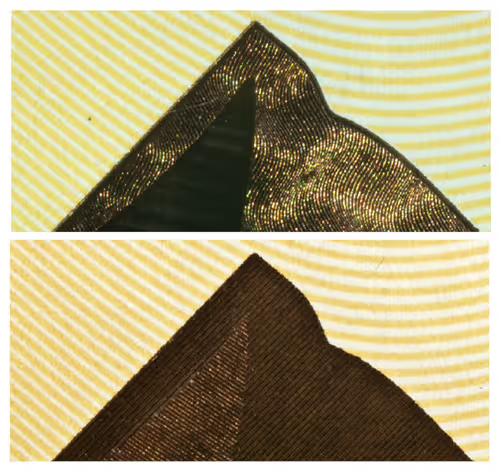

The combination of a hot stamping tool with a design pattern or logo and a holographic foil creates a completely new effect and eye-catcher. There are no limits to the variety of combinations. Unique effects can be created by using endless holographic hot stamping foil, which reflects the light differently depending on the angle of refraction.
As an alternative to the Tax Stamps' holographic foils, which incorporate individual fonts or visuals into the foil material, this can be achieved using an appropriate stamping tool. The advantage of this method is that a generic standard foil can be used and the individualisation can be carried out cost-effectively.
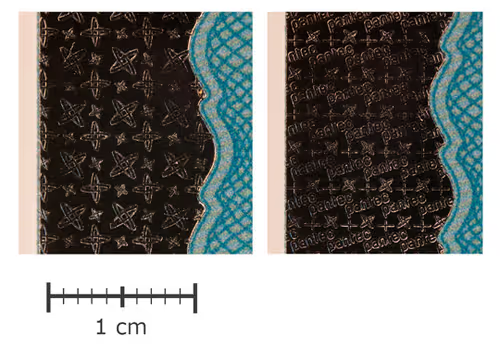
Left: “Pantec key visual” as nano application (Samples 5–8)
Right: “Pantec logotype + key visual” as nano application (Samples 1–4)
Our customer, Polish Security Printing Works S.A., requested us to run a test tax stamp production with their RHINO® S at their factory. The design was specified by the customer.
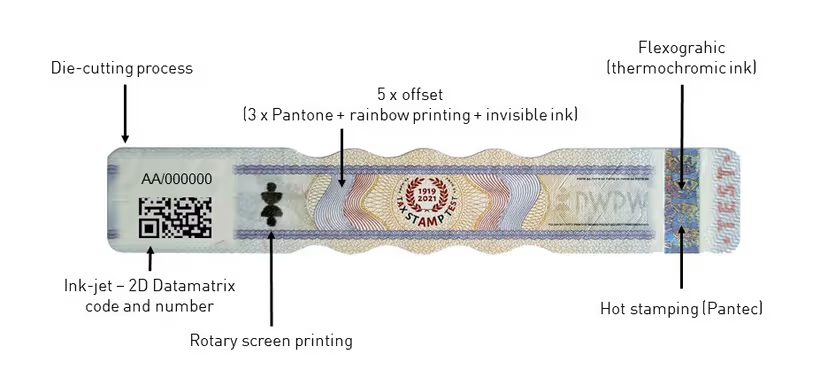
Overview of the security features applied
The holographic foil was applied lengthwise, using Kurz Holo Circle AL-OLT-12 foil. The foil itself however ran across the web to achieve the highest possible foil saving.

RHINO® — stamping lengthwise, foil across the web
Over 17,000 linear metres of watermarked substrate with an open surface were stamped using just one roll of approximately 2,000 linear metres of holographic foil. During production, the foil did not need to be changed and there were no breaks.


Various printing techniques complementing the applied hologram stripes
With web speeds of up to 150 m/min, high foil utilisation and inexpensive tooling, RHINO® is the ideal system for applying
tax stamps and offers the option to add additional security features.
RHINO® flatbed embossing system applying holographic stripes in length direction
RHINO® flatbed embossing system applying holographic stripes across the web
Ready to take the next step?
The RHINO® has proven itself in security printing projects worldwide. Contact us to discuss your specific substrate and speed requirements.
Talk to our team