Selecting the correct hot stamping foil is essential for the success of your embellishment project. By selecting the correct foil type, substrate and machine settings, you can achieve brilliant results while optimising production time and reducing material waste.
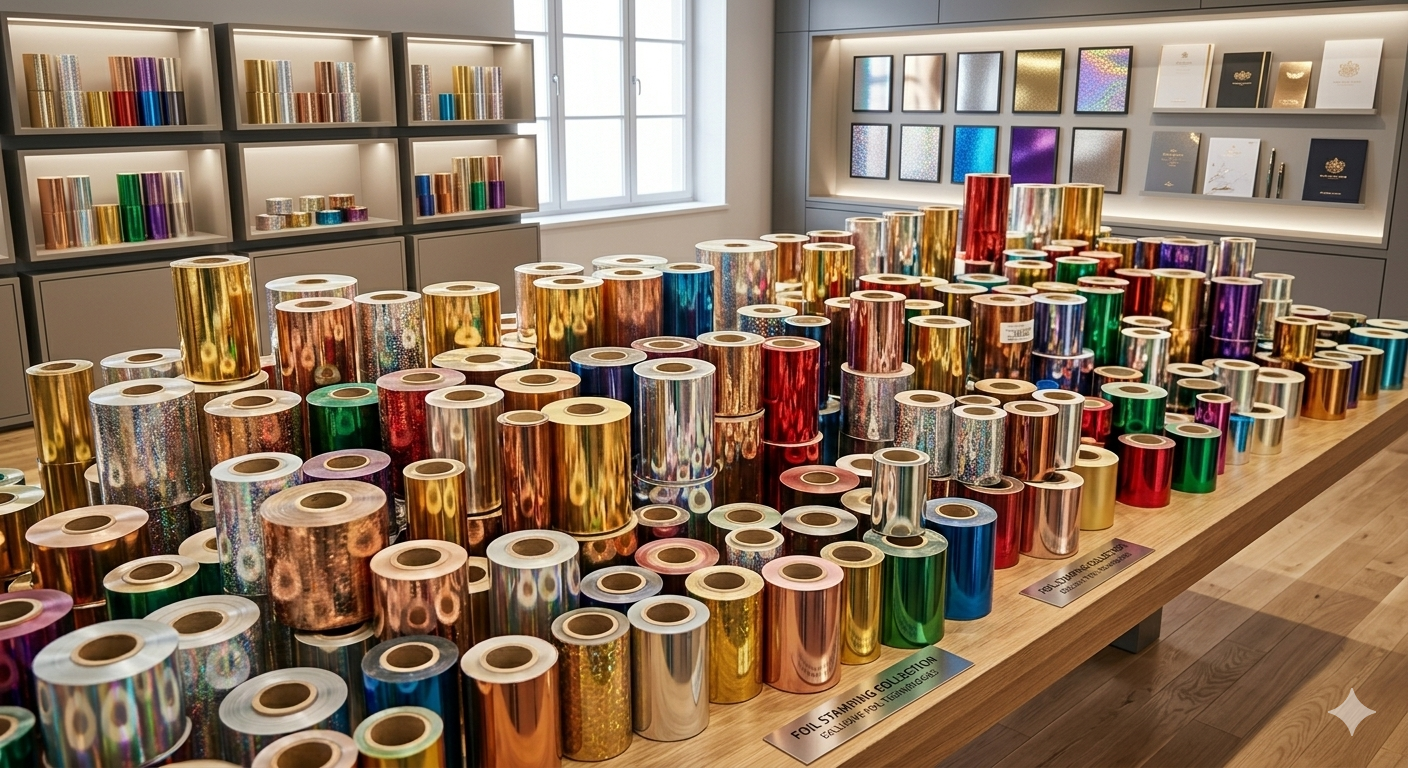
Hot stamping foil is a thin, multi-layered film that permanently transfers a metallic, pigmented or holographic finish onto a substrate through the application of heat and pressure. Unlike printing, no ink is used — the foil bonds directly to the surface through a controlled stamping process.
Note: The right adhesive formulation is critical — no single adhesive works across all substrates. Always specify your substrate when selecting a foil type.
Every hot stamping foil consists of at least three core layers: a polyester carrier film; a decorative layer made of aluminium or pigment; and a heat-activated adhesive. When the heated stamping tool presses the foil against the substrate, the adhesive releases the decorative layer, resulting in a precise and durable finish.
Hot stamping foils are produced in four primary categories — each suited to different design goals, substrates and production environments.
Choosing the right foil depends on four key factors: the substrate, machine speed, design complexity, and the desired visual effect. Getting this combination right from the outset avoids the need for costly rework and ensures consistent quality throughout the production run.
For the optimal foil selection, please contact your foil supplier.
Even with the correct foil type, results depend heavily on temperature, pressure and dwell time.
These three parameters interact — adjusting one requires compensating changes to the others.
Foil advance is one of the biggest levers for cost efficiency in hot stamping. Pantec machines are equipped with intelligent feed systems
that reduce foil consumption to the technical minimum — without compromising quality.
Rotary technology
High-speed foil application at up to 20 individual images per second and up to 10 streams. Each foil lane is controlled independently — minimum waste, maximum efficiency.
Foil Optimizer — Easy way to calculate foil usage
Pantec’s online tool for calculating foil consumption — enter your motif dimensions, set your parameters, and get instant usage and cost estimates.
The substrate is the most important factor when selecting foil. There is no universal adhesive that works across all surfaces.
The smoothness of the surface, the presence of a coating, the weight of the paper and the presence of pre-printed inks all influence
the choice of foil and the result of the stamping process.

“The foil, the substrate, and the machine are a system — optimising one without considering the others will never deliver consistently outstanding results.”
Berat Abazi
Application Engineer | Pantec Schweiz AG
Hot stamping foil is often mistakenly considered unsustainable because of the plastic carrier film. The reality: the PET carrier is fully removed after the stamping process and never reaches the end consumer. Only an ultrathin metallic layer remains in the finished product.
Minimum material — maximum impact
A single coffee capsule contains enough aluminium to decorate approximately 1,400 boxes with a full metallic finish. No other decoration process is as resource-efficient.
Note: Hot stamping is the only metallic decorating process in which no plastic film is transferred to the finished product — a decisive advantage over metallised laminates in terms of recyclability and regulatory compliance.
Ready to take the next step?
Pantec’s application engineers support you in matching the right foil to your substrate, machine and process.
Talk to an expert